

Why Most Startups Look Broken Right Before They Takeoff

There’s a specific phase in company building that almost no one warns you about.
Not the early beginning, where excitement supercharges your every step or the later stage, where traction provides a secure predictable way forward.
I’m talking about the middle stretch in the infamous startup valley of death ☠️
The one where you’ve done enough work to a point where it is no longer a hobby, but not enough results for the work to become a viable scalable business.
This is the difficult phase where most startups look broken.
I’ve seen it as a founder, as an operator, as an advisor to hundreds of businesses across different industries and stages.
I call this phenomenon The Effort-Evidence Lag.
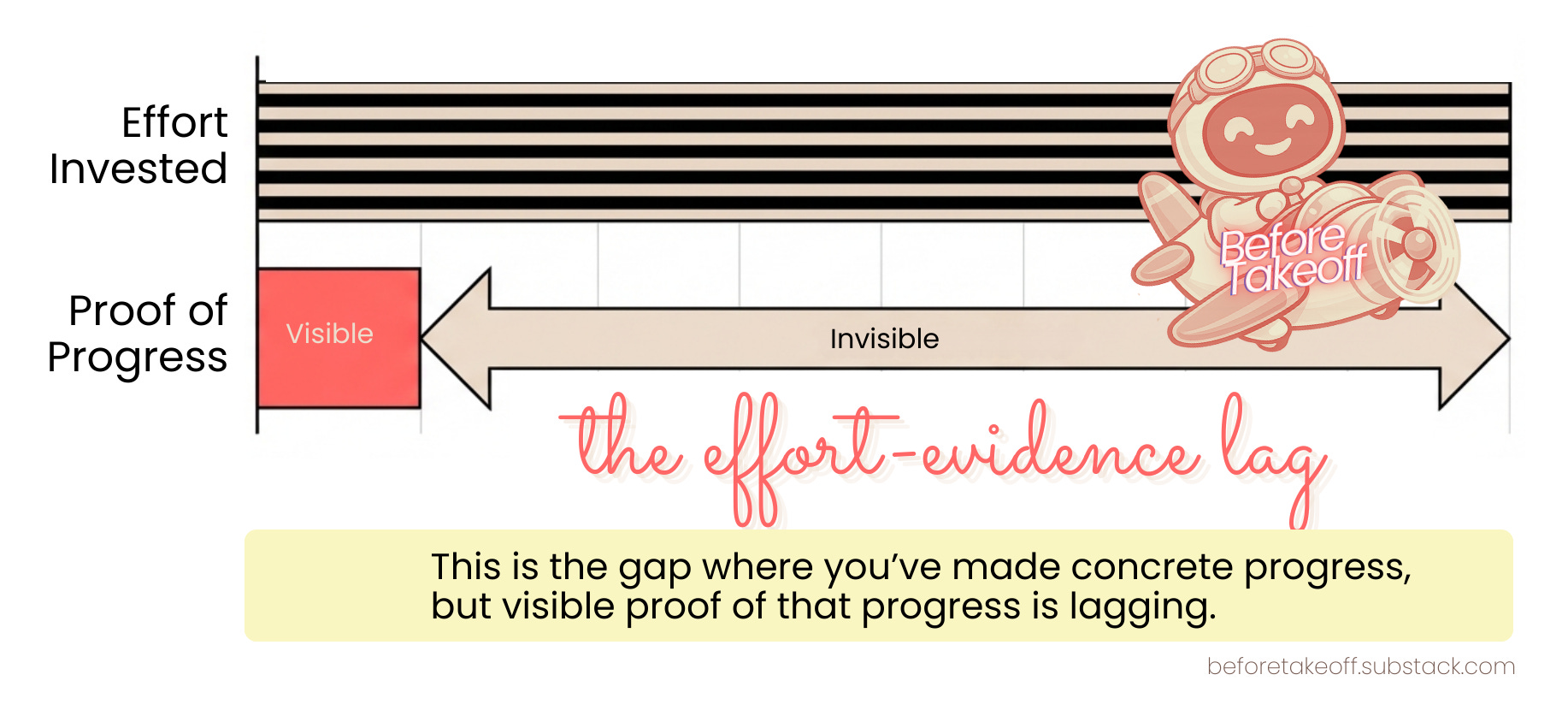
🕳️ The Effort-Evidence Lag
The Effort-Evidence Lag is the distance between actual progress and visible evidence of progress.
In the earliest days, effort and evidence of progress are often hand-in-hand. You do something, you see a reaction. You ship a feature, you get feedback. The feeling of forward movement and momentum is exhilarating.
Then, quietly, as your startup matures, the gap of visible progress on effort widens.
You’re making better decisions, but results lag.
You’re learning faster, but nothing external reflects it yet.
You’re doing fewer wrong things, but not enough right ones have compounded.
From the inside, this feels like stagnation. On the outside, it looks like nothing is happening.
This is where founders start panicking or start feeling defeated.
In reality, they have not failed or stalled, but they’ve lost momentum clarity.
The signals of progress have become slower because of harder goals, noisier, and more complex to interpret. And humans are terrible at staying calm when effort stops producing immediate reassurance.
So they reach for what I call Visible Motion.
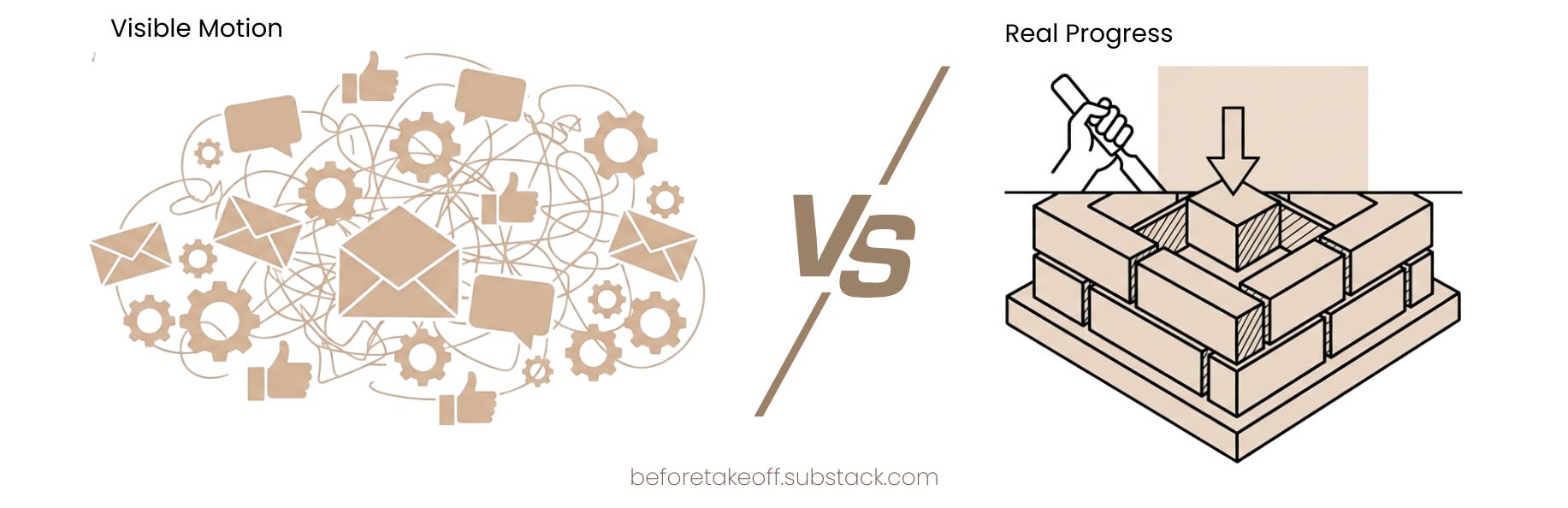
💨 Visible Motion vs. Real Progress
Visible Motion is activity that looks impressive, but doesn’t close the Evidence Gap.
Promoting on more channels.
Pumping out more content.
Adding more features.
Chasing more ideas.
Real Progress, on the other hand, is usually quieter and much less shareable on social media.
It looks like:
Narrowing your ICP instead of expanding it
Saying no to demand that is not your core priority now
Rebuilding something that “kind of worked” but wasn’t reliable
Repeating one boring action continuously until it starts to work
Visible Motion feels productive. Real Progress feels slow, tedious, and painful.
This is why many startups look worse right before they work. They’re slowing down at times faster than results can show up.
To outsiders, it looks like deceleration. To the founder on the inside, it feels like doubts of whether it will ever work.
This is an inevitable trap many new founders fall into.
🎯 The Progress Expectation Trap
Most founders are operating with an unspoken mental model that progress should look like a slope.
Up and to the right.
Effort in, results out.
More time invested equals clear visible progress.
But real startup progress shows up looking more like a staircase of growth.
Long flat landings.
Sudden vertical jumps.
Then another long, uncomfortable pause.
The flat parts are where capability and clarity build. The jumps are where they finally get translated into meaningful results.
What gets misinterpreted as “nothing is happening” is often invisible progress accumulating below the surface.
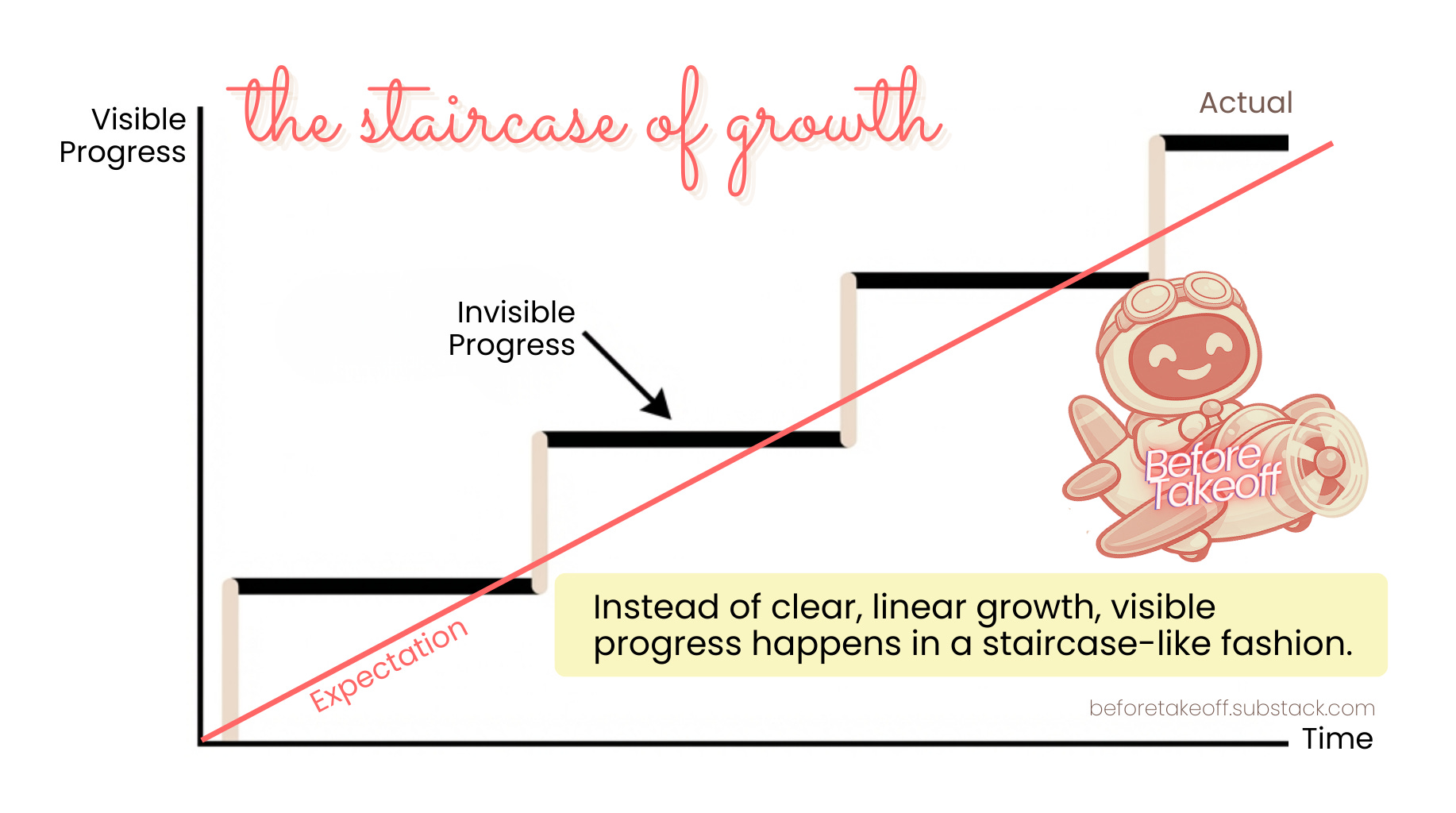
Here’s how I distinguish the two in the above Staircase of Growth chart.
🚨 The Three Signals That Precede Traction
When revenue, growth, or recognition aren’t reliable yet, I look for three internal signals. I’ve used these across advisory work, early-stage startups, and companies on the brink of accelerating momentum.
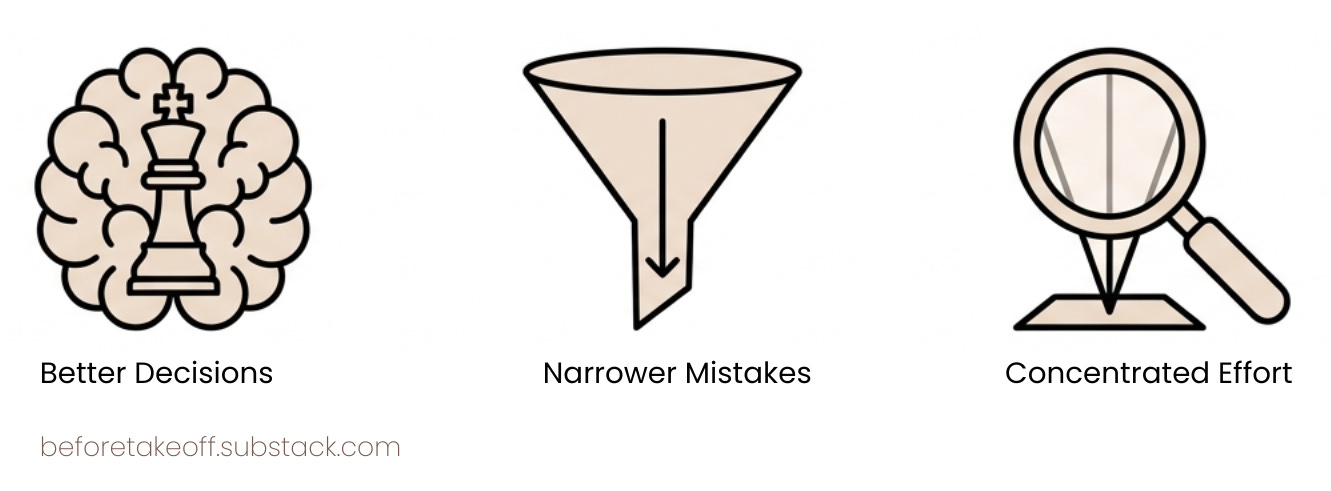
Decision Quality Is Improving
Fewer reactive moves and more deliberate tradeoffs. Clearer data-backed reasons for saying no after months of experimenting, tracking, and reviewing of what works and what doesn’t.Mistakes Are Getting Narrower
Early mistakes can seem chaotic and all over the shop. Later “mistakes” are more tactical, targeted, and intentional to validate or inform on key assumptions.Effort Is Concentrating, Not Expanding
Less “trying everything” and more editing, repeating, and refining of the one to two things that almost worked until it works.
If the above are happening, the startup is not broken. It’s calibrating and slowing down can help make the calibration successful.
💪 Why Slowing Down Can Be a Strength
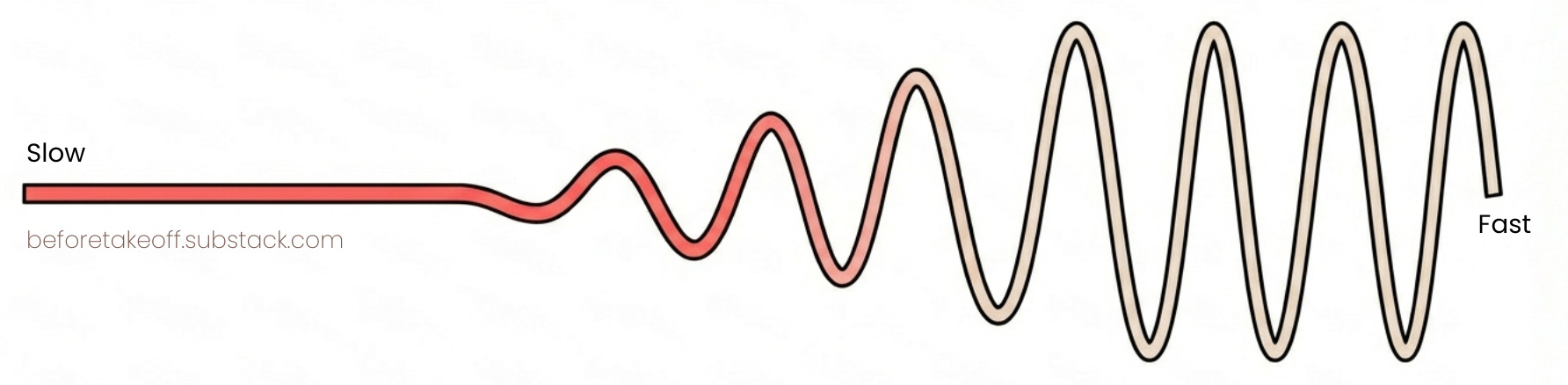
Slowing down gets a bad reputation in a world where speed is worshipped. But it can serves a critical function, especially during calibration of where and how to proceed.
When you’re not busy sprinting, you get to:
Ensure what you’re building is truly valued and viable
Kill ideas because you can see clearly what matters
Rebuild foundations required for sustainable, scalable success
This is how many of the strongest startups quietly reorient themselves.
The danger isn’t being left behind. The danger is trying to present success before your product has earned true coherence with your market.
I’ve watched founders burn years chasing optics and vanity metrics while their core value proposition, moat, and product-market-fit stayed fragile. And I’ve watched others disappear for a while, only to re-emerge with something that can work sustainably at scale because it’s finally aligned with market demand.
Which brings us to our final Before Takeoff ✈️ framework for today.
🏔️ The Readiness Threshold
Things don’t keep working continuously in the same pace. Once key conditions are met, they cross a threshold and explodes exponentially.
The conditions include:
Having an offer that matches a real, recurring, monetisable pain at scale
Developing a delivery mechanism that can sustain demand
Finding
a blue ocean market/niche where no competition exists yet or
a unique, defensible moat that cuts through the noise in a competitive space
Before that threshold, pure hustle, without being strategic, rarely helps. After it, progress accelerates almost uncomfortably fast.
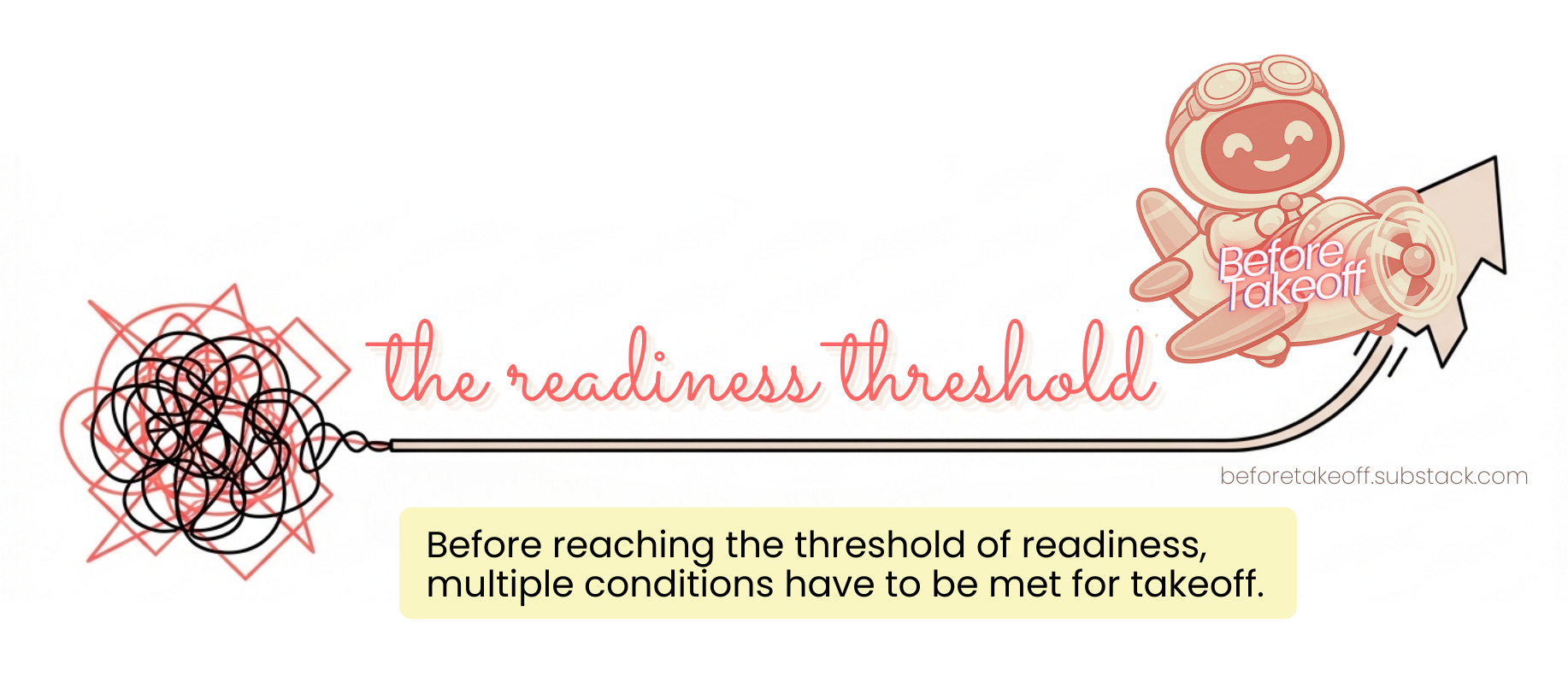
This is why the moment before takeoff can feel so disorienting and even discouraging. You’re doing work that do and will matter, but you can’t yet prove it.
If you’re confused, tired, or doubting yourself, that doesn’t mean things aren’t working.
It means you’re inside the Evidence Gap where visible proof of progress isn’t reflecting actual progress yet.
This Substack exists for that awkward phase of growth.
Not to hype you up or hand you generic advice, but to help you interpret what you’re experiencing while you’re still in it.
Because most startups don’t look like overnight success stories when the stories are still being lived, particularly at the point before takeoff ✈️
Follow me on LinkedIn at https://www.linkedin.com/in/sylviahuangchannel/