

Startup Anxieties: The 7 Constant Saboteurs Living in the Founder's Mind
Why Your Greatest Business Risk Isn’t Your Runway but Your Mind

Most founders who start a business expect to feel anxiety. What they don’t expect is the specific shape that pressure takes.
The startup conversations around anxiety tend to focus on the obvious:
fear of failure, fear of running out of money,
fear of making the wrong call.
These are very real fears, but founders are, to some extent, equipped for them. Spreadsheets and advisors help address runway concerns, contingency plans help prepare for execution failures and market shifts, and founder communities often share their learnings generously to cover knowledge gaps.
Beneath these visible, somewhat manageable threats lies a silent layer of psychological pressure that almost never makes it into the startup narrative.
Over the past decade, I have sat with early-stage founders across hundreds of 1-1 and group advisory sessions. The business risks on the surface are rarely what quietly erode early stage founders. It’s this under-discussed layer of seven constant anxieties that arrive without invitation, operate nameless, and silently shape decisions that does the most damage.
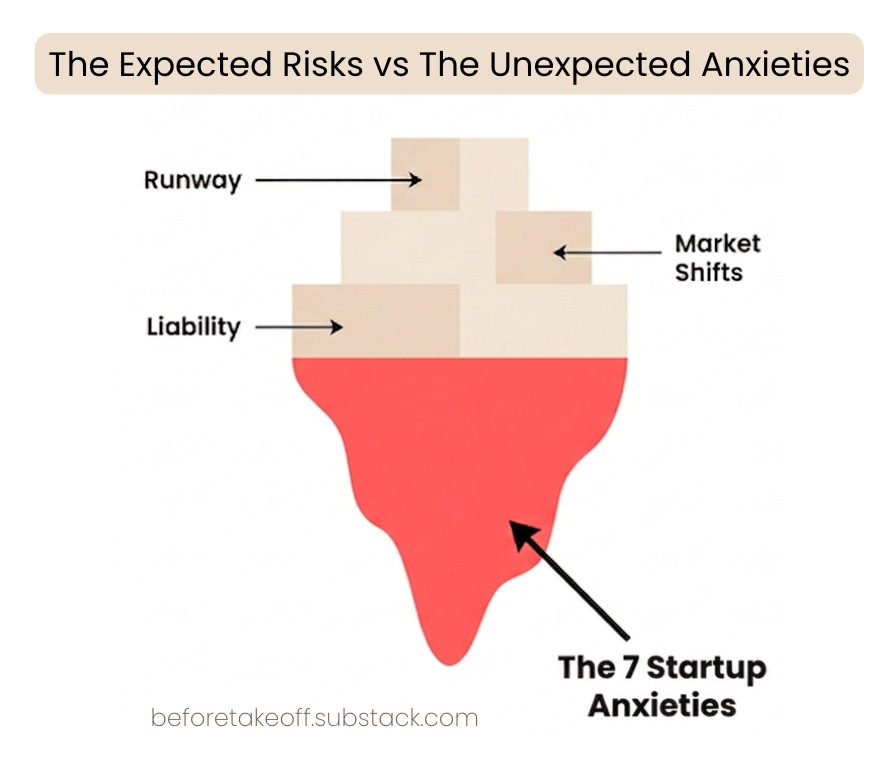
Because most founders can’t name these anxieties, they dismiss them as personal weakness, misattribute them to a fixable tactical problem, or assume they are the only one feeling this way.
They’re not. Here is what the seven constant saboteurs of the early stage founder’s mind are, what they cost, and how to take on each one.
Output Anxiety: The Guilt of the Invisible Labor
There is a persistent, unspoken pressure in early-stage building to constantly build, post, ship, and repeat. Essentially, to have something to show every day.
What founders don’t anticipate is the guilt that accumulates on the days when the most important work is happening entirely inside their heads or over endless AI-chat threads.
When you spend a morning reviewing what’s working and what isn’t, an afternoon mapping strategy, an evening reading about your market, and produce nothing visible, it can feel like you didn’t achieve or produce much that day.
The anxiety here is caused by conflating tangibility with productivity.
Thinking is producing and insight is output. The structure that guides future execution is also output.
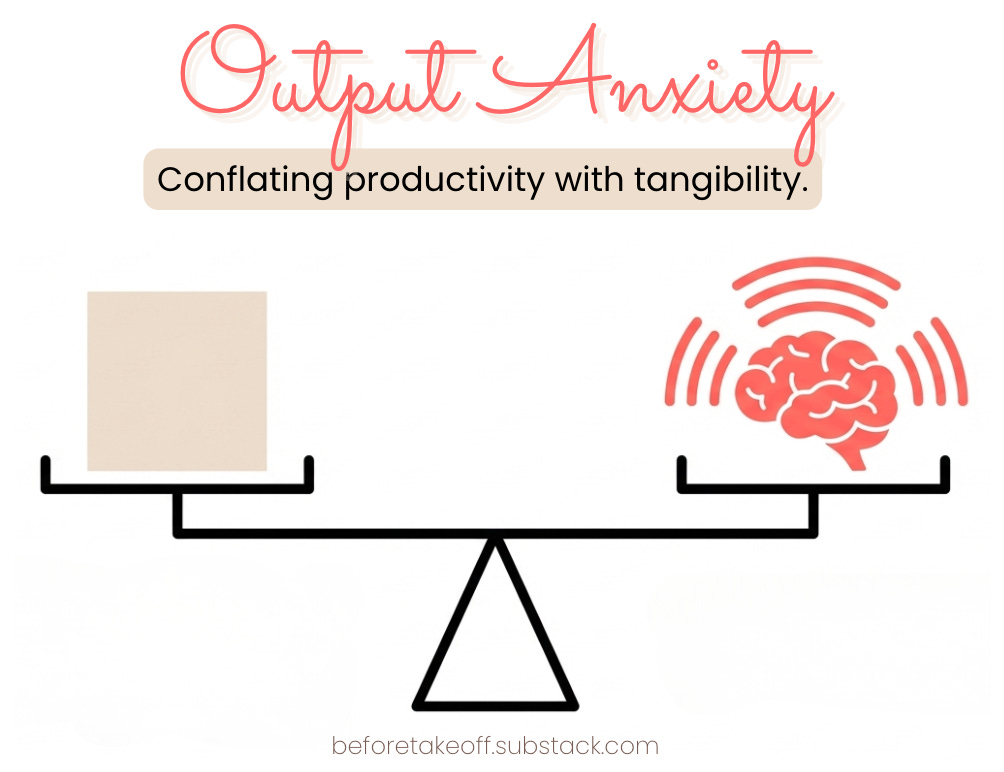
Some of the highest-leverage founder work is invisible, and the anxiety that surrounds it often leads founders to skip the reflective work entirely. And that is precisely when decisions start to drift and strategy becomes reactive.
When gripped with output anxiety, keep in mind that skipping reflective work doesn’t actually save you time. Doing so undermines your future success and will ultimately cost more than just time.
Rejection Anxiety: The Verdict on the Self
Founders are often required to take their product to market before it’s fully ready. This is often the stage where the messaging isn’t sharp, pitch isn’t tested, and the positioning is filled with gaps.
Even founders with a strong conviction in what they’ve built carry an anxiety that:
the market won’t see what they see
they’re targeting the wrong person
even if the product is strong, the weak positioning will fail to cut through
What makes this anxiety particularly difficult is that rejection at this stage isn’t abstract. It’s deeply personal as you have made countless sacrifices to direct your precious dreams, savings, resources, and time into this thing.
The first time someone responds with silence, polite disinterest, or a direct “no,” it doesn’t feel like a data point, but more like a verdict on you.
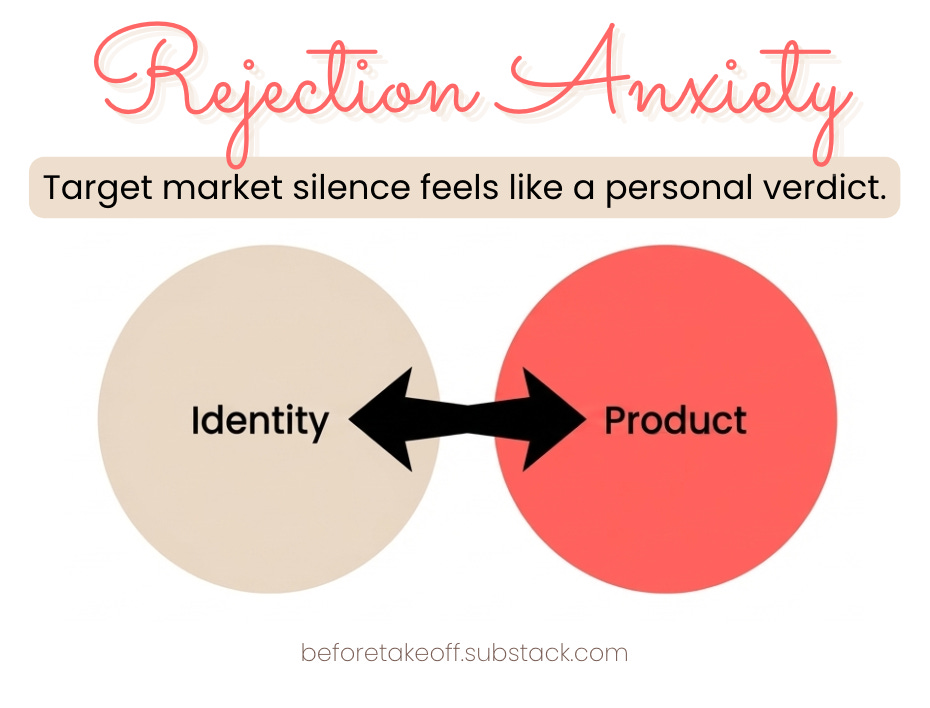
Because you pour your identity into the venture, a polite “no” rarely registers as neutral information. Every cold conversation becomes a high-stakes emotional gamble of scoring an A+ or a F.
This anxiety ends up creating hesitation at the exact point of your business building journey where you most need to be iterating often and quickly.
To overcome or manage this anxiety of rejection, master Identity Decoupling. Your value as a person or entrepreneur is not the same thing as your current product-market fit. A market ‘no’ is feedback about the offer, not a verdict on you.
Catastrophe Anxiety: The Fragility of the Win
This one hides behind good news.
Even when things are going well, such as a promising conversation, a new client signed, momentum beginning to build, founders often find themselves waiting for the inevitable collapse.
The business, especially in the early stages, is a structure built on sand. The foundations are still being laid while the house is already being lived in.
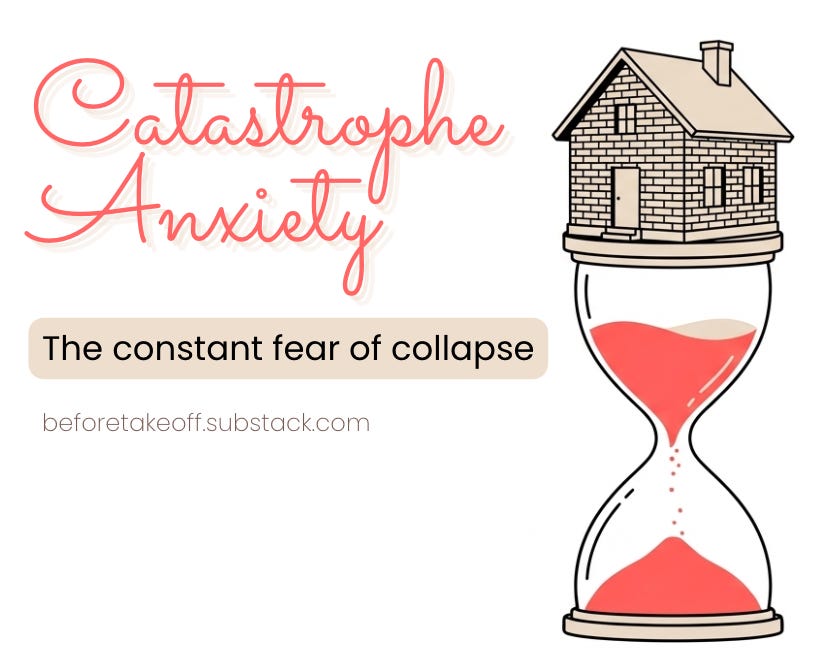
When things are rocky, this anxiety intensifies. And when things are going well, it doesn’t disappear either and simply changes form.
Success feels fragile because it is fragile. That awareness isn’t a flaw in the founder’s thinking, but a very real every day reality of a business in its early years.
The danger here is when this anxiety becomes so persistent that it paralyses the ability to take the risks necessary to turn a fragile win into stable success.
Because if every gain feels like it could be taken away at any moment, you stop building boldly and start to manage defensively. And defensive management rarely compounds into massive victory.
When faced with catastrophe anxiety, know that you are not being irrational. It’s true that at this stage, your business is fragile, but keep building anyway.
Success Anxiety: The Price of Arrival
The question founders often ask out loud is: “When will things finally take off?”
And the question lingering deep in their consciousness if: “What happens if they do?”
Success, for early-stage founders, isn’t always the clean gains-only arrival it appears from the outside. There is a real, rarely-spoken anxiety about whether success will come with costs such as
changing them into a person they don’t like or want to be
distancing them from the people they love and care for
coming with terms and trade-offs they aren’t quite willing to pay for
increasing the isolation that comes at operating at a higher level
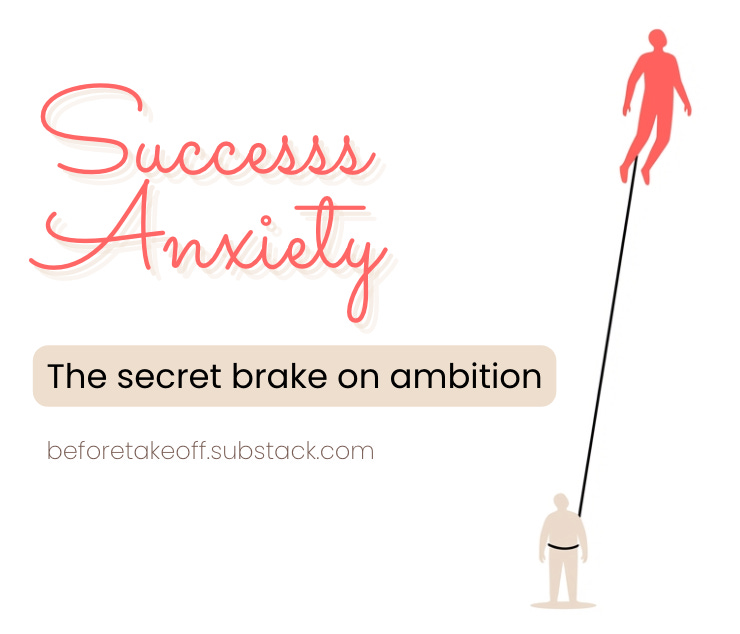
This success anxiety can subconsciously act as a secret brake on ambition, causing founders to sabotage or limit their own growth in order to keep things as they are.
Are you afraid of how success might change you or the things and people you care about? Get on YouTube and hear from entrepreneurs who have arrived. This way you are equipped with what’s to come and fresh insights you might not expect.
From there, knowing the costs involved, decide how big you want your business to grow and at which point, you might put a lid on scaling it further.
Judgment Anxiety: The Audience in the Room
Most founders expect the hardest part of visibility to be strangers’ judgment. In my advisory experience working with countless founders over the years, it rarely is.
The harder part is the people who already know them. The family members who ask loaded questions at gatherings. The former colleagues quietly watching whether the bet pays off. The friends who haven’t said anything critical but whose silence reads as scepticism.
This anxiety, more than any other, is what drives founders to hide rather than build in public.
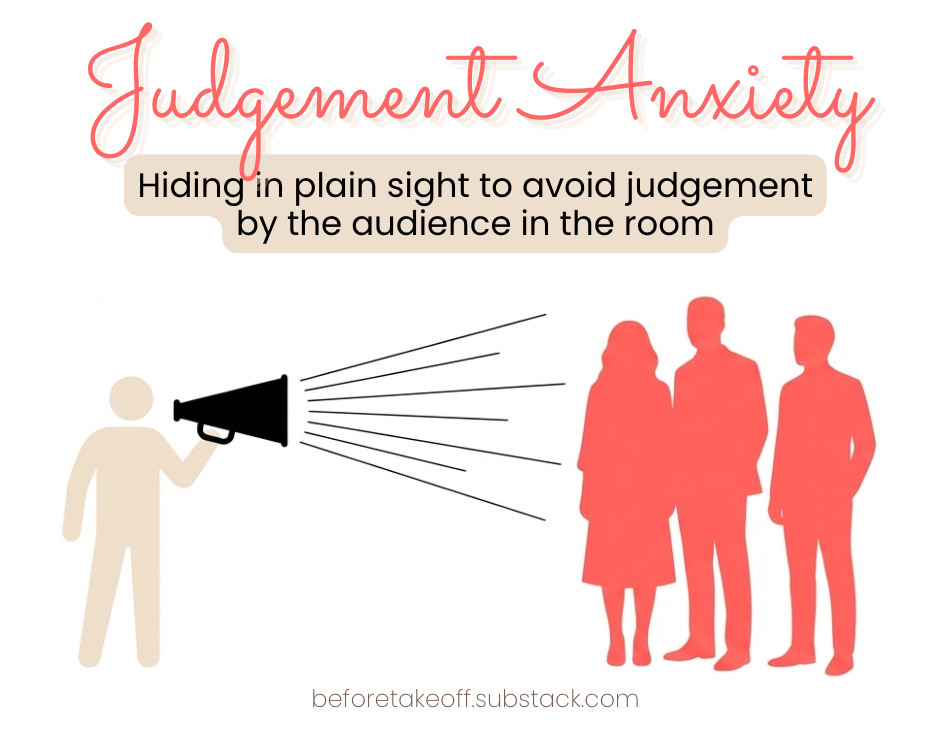
They will push back on building visibility because they cannot bear the thought of people close to them watching them try and fail or fall short publicly.
The business cost of staying invisible because of this anxiety is something I covered in “The Distribution Chasm: Why Founders Who Build in Silence Stay Invisible”. It's worth reading this piece alongside this current one.
The outcome is a founder who becomes invisible to the exact audiences they need to reach, due to their desire to protect their reputation with a much smaller, closer group who aren’t even their target market.
When faced with judgment anxiety, remind yourself to not sacrifice your business’s future to avoid being judged by people who aren’t even your potential customers. Build for your ideal customers, not for your inner circle or acquaintances.
Time Anxiety: The Debt of the Unfinished
In the early stage, when you are the everyone in the business as the strategist, executor, marketeer, customer service team, finance team, and chief evangelist, time is the most acute daily pressure.
There is never enough of it. Not for
the work itself
the day job that funds the dream
the family, friends, and loved ones who wants you to be present more
the mental and physical health maintenance that keeps you functional and sharp
the life admin that doesn’t go away just because you’re now an entrepreneur
Every hour allocated to one area is taken from somewhere else, and the neglect in the robbed area accumulates until the consequences hit you at some point.
What makes this anxiety particularly resistant is that it rarely resolves with better time management. The root of the anxiety isn’t inefficiency.
It’s carrying a full life in both hands while trying to build a third thing with no spare hands left. And often times, that tension cannot be entirely organised away with a better calendar, a smarter productivity system, or AI.
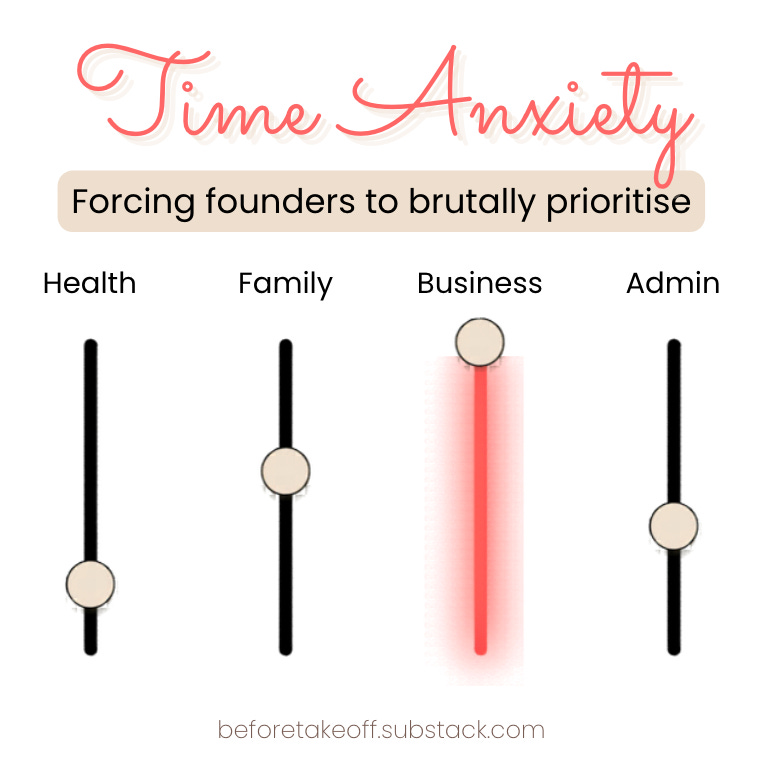
It can only be navigated, with one deliberately chosen trade-off at a time. Olympians didn’t become the best in the world for their sport by trying to do it all. They chose their top priorities and accepted that other priorities will have to take a backseat on most days.
When tackling time anxiety, know that it isn’t a scheduling problem, but a constraints problem. And the answer isn’t a more powerful system, because even designing, setting up and maintaining systems cost time. The solution lies in a more brutal prioritisation about what matters most in this specific season of your life.
Permanence Anxiety: The Long Hallway
This one arrives quietly in the founder’s mind after the initial buzz has faded.
Repeatedly in my advisory work, I see it manifest as the most corrosive of the seven startup anxieties for countless founders.
There is a long stretch in the early years of building where nothing changes very much. Every day looks and feels the same. The silence is consistent. The grind is relentless.
And gradually, a killer doubt slips in: “What if this right now is forever?”
The longer the plateau lasts, the more inevitable permanence starts to feel. It stops looking like a temporary phase and starts looking like the destination.
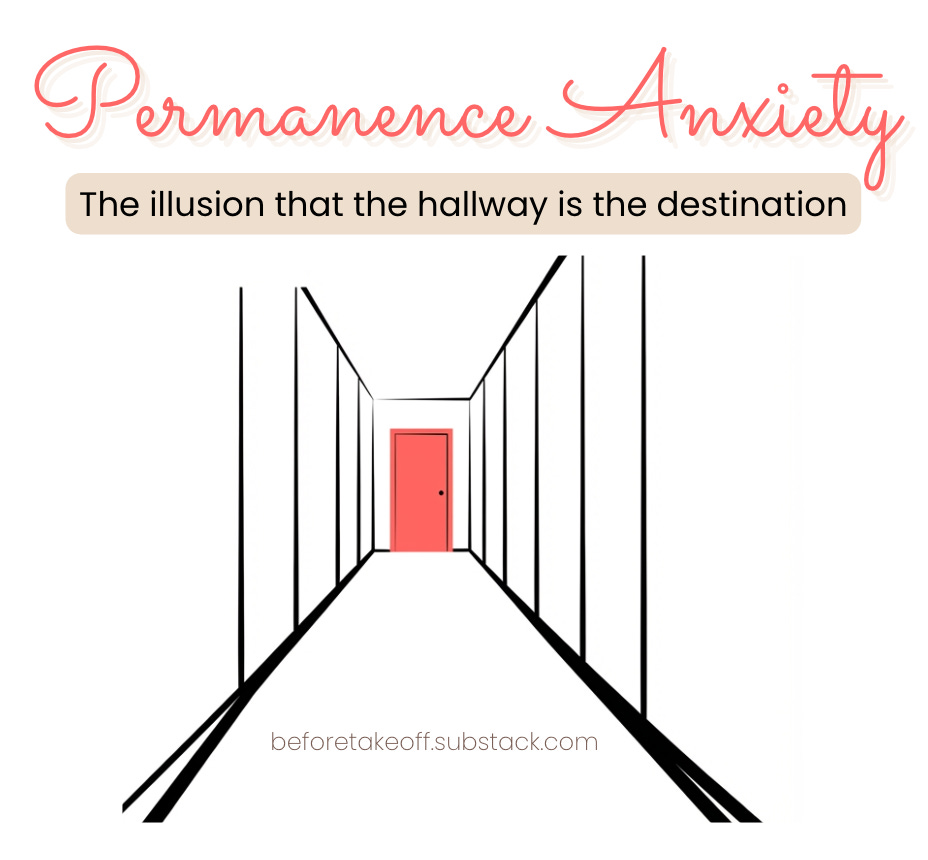
But permanence in early-stage building is almost never the reality. What looks like a dead end is almost always a long hallway. Zoom lived in that hallway for 7 years. If you're in it right now, read about “Zoom's 7 Quiet Years No One Talks About“ here.
Yet if you stay long enough, a door will eventually appear in the form of a new messaging angle, a refined offer, a customer acquisition channel that works, or a different ideal customer profile that takes off.
And if, after an extensive period of sustained effort, the door genuinely isn’t there, that’s also an important insight, telling you that it’s time to pivot, pause to recharge, or exit for good. But that clarity requires often staying in the hallway long enough for the information to arrive.
When weighed down by the permanence anxiety, remember that you are not at a dead end. You are in a long hallway and just need to be walking along it long enough for the insight to arrive.
Naming the Ghost
Here is what I’ve come to understand about these unnamed startup anxieties, after years of sitting with founders through the long, uneventful parts of building.
An anxiety you cannot name has enormous power. It shapes your strategy from the shadows and convinces you that your struggle is evidence of failure.
Naming these anxieties strips them of that power.
It transforms them from being a vague, corrosive background noise into something you can isolate or even silent. The most successful founders aren’t immune from having these anxieties, they simply learn to work despite it.
Which of the 7 is quietly acting as a secret brake on your momentum right now?