
Have You Built a Business or a Cash-Eating Monster? What Profit First Can Teach Founders
A practical look at profitability, cash flow, owner pay, financial runway, and building a business that can actually sustain its founder

A business can look increasingly successful while gradually becoming harder for its founder to sustain.
Revenue is growing. Customers are coming in. The founder is busier than ever. Yet the bank balance remains uncomfortable, the founder barely pays themselves, and every unexpected bill causes a small financial crisis.
This is the uncomfortable possibility behind one of the central ideas in Mike Michalowicz’s Profit First: growth does not automatically fix weak business economics.
If most of the money generated by each sale immediately disappears into delivery, contractors, subscriptions, software, marketing and operating costs, scaling may simply create a larger cash-eating machine.

For solo and bootstrapped founders, this matters particularly early. You probably have less runway, fewer financial buffers, and far less room to keep funding a business that looks commercially active without becoming financially healthy.
1. Profit Cannot Always Wait Until Later
A common early-stage assumption is that profitability is something to worry about once the business becomes bigger.
For now, you reinvest everything. You buy another tool, hire some help, spend more on the product, upgrade the website, add another service or pour money into customer acquisition. The reasoning sounds sensible: grow first, become profitable later.
The trouble is that later does not automatically change the economics you are creating today.
If a $1,000 sale currently requires $850 of costs to win, deliver and support, ten times the sales may simply create ten times the operational burden.
Profit First reverses the usual behaviour by allocating profit before allowing expenses to consume everything available. The percentage can start very small. Even allocating one or two percent forces the founder to operate with the money that remains rather than treating every dollar in the account as spendable.
This creates a much more useful constraint: could this business still operate if it had to leave something behind for its owner?
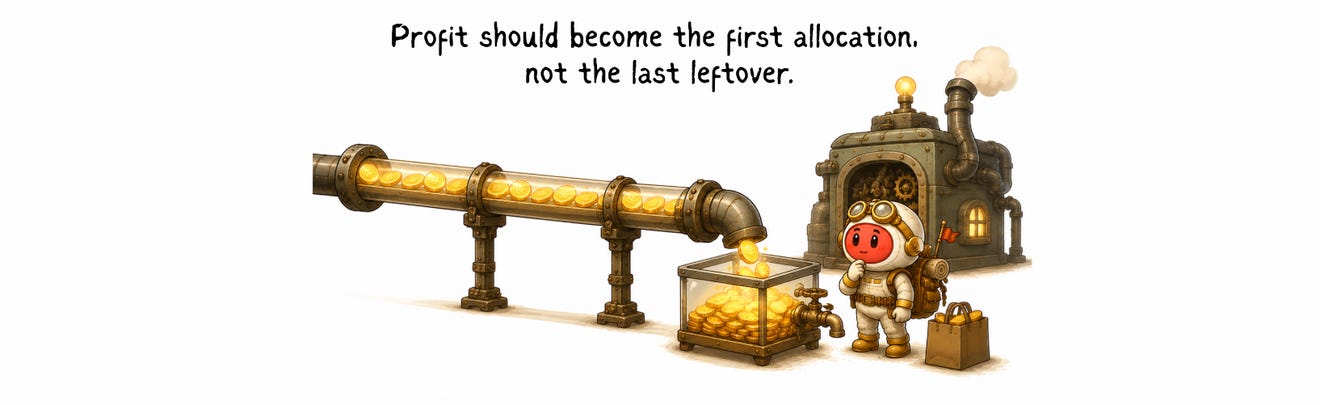
If the answer is no, the problem may not be insufficient growth. The business model itself may need attention.
2. Your Revenue Number May Be Flattering You
Early revenue feels important because it is. Getting customers to pay proves far more than likes, compliments or enthusiastic conversations ever will.
But revenue can also become a misleading success metric.
Imagine a consulting founder who invoices $20,000 this month. On paper, that looks like a strong month.
Except $8,000 goes to subcontractors, $3,000 to software and operating costs, $2,000 is effectively owed to tax, several invoices will not actually be paid for another 60 days, and the founder still needs to pay themselves.
Suddenly, “$20,000 in revenue” tells a very incomplete story.
Founders need to distinguish between what has been sold, what cash has actually arrived, and what remains after the direct cost of delivering those sales.
This matters because cash pressure changes behaviour.
When the bank balance becomes painfully low, founders often start accepting customers they would normally decline, discounting work, taking badly scoped projects or launching quick offers purely because money needs to arrive.
More sales then create more work without necessarily creating a healthier business.
Not all revenue gives you more runway. Some revenue consumes it.
3. One Bank Balance Can Make You Feel Richer Than You Are
A founder opens their banking app and sees $20,000.
Founder brain understandably interprets this as: we have $20,000.
Except perhaps $5,000 belongs to tax, another portion needs to cover delivery, some should become owner’s pay, and several upcoming bills are already committed.
The available operating money may be dramatically smaller.
The Profit First approach separates money into different purposes, such as income, profit, owner’s pay, tax and operating expenses.
There is a behavioural advantage here that goes beyond bookkeeping.

When all your money sits in one pile, every expenditure competes against an artificially large number. A $500 subscription feels affordable against $20,000.
When the operating account tells you that only $4,000 is genuinely available to run the business, the same decision suddenly looks different.
For a bootstrapped founder, that visibility can sharpen judgment. You begin asking whether another piece of software, contractor, feature, campaign or recurring cost deserves to consume the limited money available to keep the business moving.
4. Your Business May Have an Investor You Never Named
There is another uncomfortable calculation many bootstrapped founders leave out.
Your spouse or partner may already be investing in the business.
They may never have transferred $20,000 into the company account. But perhaps they are covering more of the rent, groceries, mortgage, insurance or household costs because you are taking little or no income from the business.
That is still runway. The business is effectively consuming household capital rather than company capital.
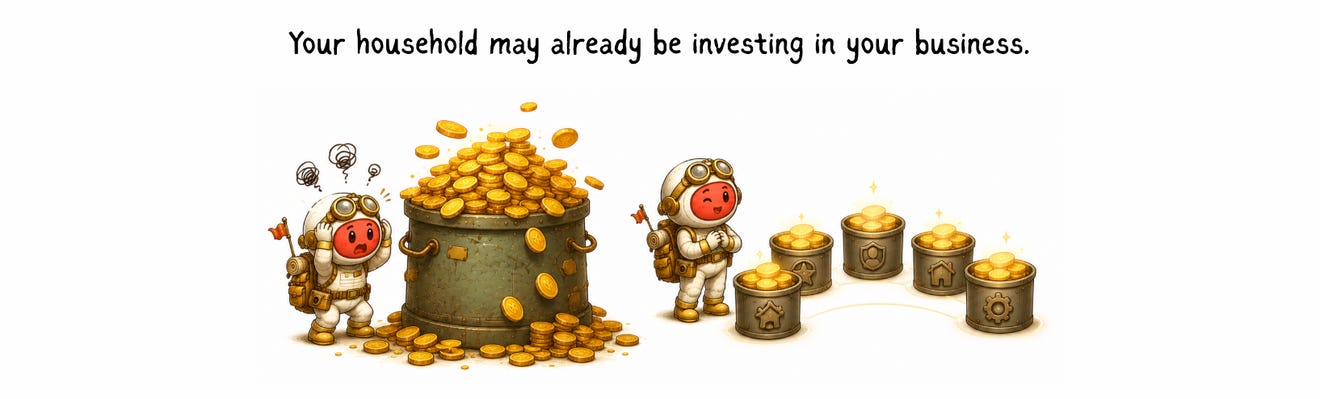
This does not automatically make continuing the business irresponsible. Many businesses are supported this way during their earliest stages. But the commercial risk should be visible to everyone carrying it.
That means being clear about how much personal money is being committed, how long that arrangement can continue, what evidence would justify extending it, and what would trigger a pivot, pause or return to paid work.
Founders regularly set ambitious revenue goals. Far fewer set a boundary around how much they are prepared to lose while pursuing them.
The second number can be just as important as the first.
5. Every Bootstrapped Business Needs a Stopping Rule
Optimism is useful entrepreneurial fuel, right up until it starts moving the goalposts.
“I’ll give this six more months” quietly becomes nine.
“I’ll invest another $5,000” becomes $15,000 because the new product is almost ready.
“We just need more customers” becomes another expensive marketing campaign without fixing weak margins underneath.
A stopping rule decides some of these boundaries before financial pressure and emotional attachment are at their highest.
It might include a maximum personal investment, a limit on high-interest debt, a break-even deadline, or a milestone that triggers a major change in the business.
Missing that milestone does not necessarily mean shutting everything down. It might mean simplifying the product, narrowing the customer, changing the delivery model, reducing fixed costs, returning to part-time work or questioning whether the current version of the business deserves more capital.

The purpose is not to kill ambition.
It is to stop belief becoming permission to ignore accumulating evidence.
A Business Should Eventually Support the Founder Building It
For an early-stage founder, profitability does not need to mean extracting large amounts of cash while starving the business of investment.
But there is a meaningful difference between deliberately reinvesting in something with strengthening economics and endlessly subsidising something whose economics never improve.
Look at the last six months of your business. After the direct costs required to deliver what you sold, how much genuinely remained for tax, operating costs, owner’s pay and profit?
Then ask the harder question: If this business had to pay me properly and retain even a small profit today, what could it no longer afford?
Perhaps you discover unnecessary software, expensive custom delivery, weak pricing, excessive contractor dependency, or an offer with poor margins.
That answer may be uncomfortable, but it gives you something useful: a clearer view of the business you have actually built.
Because a business that grows while consuming more cash, more founder energy and more household runway with every new customer is not necessarily becoming stronger.
Eventually, the business should support the person who built it.
Otherwise, you may not be building a financial asset yet.
You may simply be building yourself an increasingly demanding job with a very unreliable salary.
🧠 If today’s article resonated, you may want to read these next:
Startup Revenue Maturity Curve: Why the Path to the First $100K is Different at Every Stage
The Babylonian Blueprint: What The Richest Man in Babylon Reveals About the Founder Journey
The Power of Broke: Why Constraint Can Make a Founder Sharper
True. That’s why knowledge about cash flow and reserves are so important. Easy to judge numbers on paper, that doesn’t always translate into reality!! if a business isn’t supporting your life… then is always a key thought to reconsider it