

Price’s Law and the Paradox of Productive Scaling for Early Stage Founders

Something I have observed repeatedly in my advisory work is that founders tend to view their capacity problem as a resource problem.
They do not have enough time, people, and budget. So the instinct is to add. More hires, softwares, and ironically more activities. The assumption behind that instinct is that more input produces proportionally more output.
Price’s Law suggest something else about that assumption.
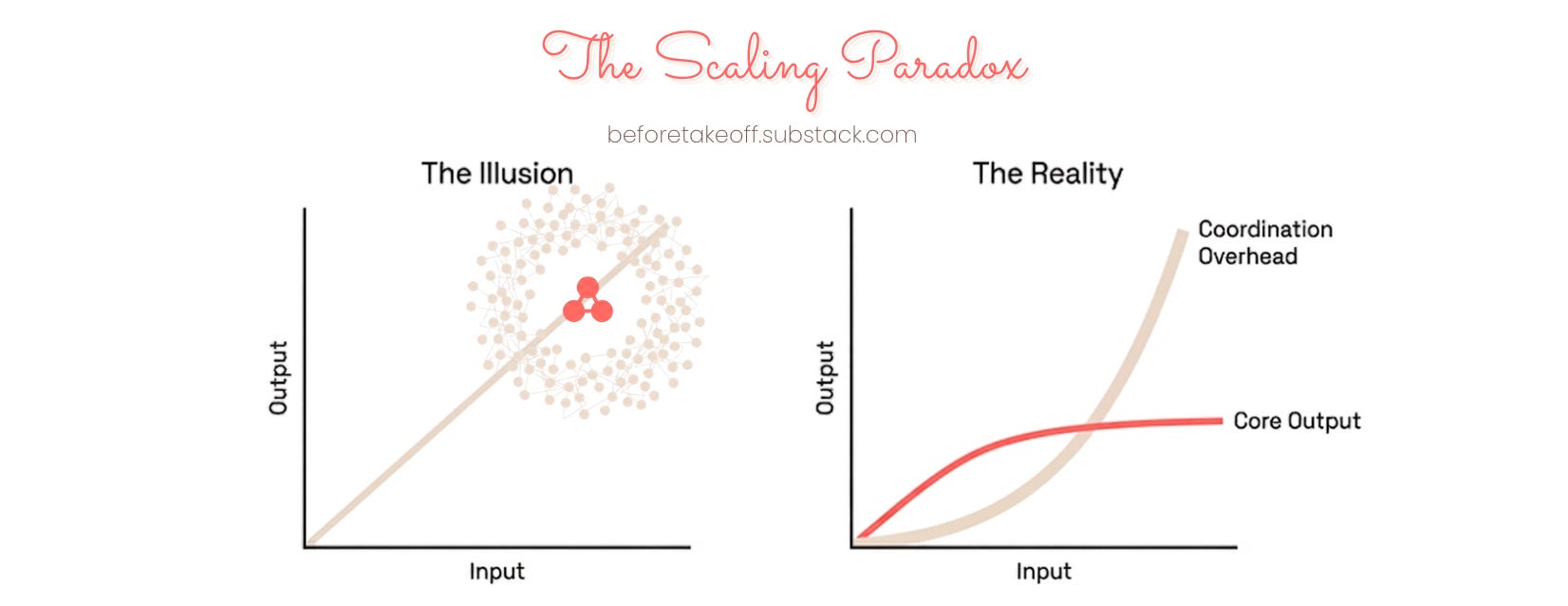
Price derived this from academic publishing data and the underlying dynamic maps onto any group/team where contribution is not uniformly distributed.
The Scaling Math Founders Need to Know
Price’s Law was derived by physicist and historian of science Derek J. de Solla Price.
The principle is simple: in any group or organisation, 50% of the total productive output is generated by the square root of the total number of contributors.
In a team of 100, ten people are doing half the work. In a team of 10,000, one hundred people are.
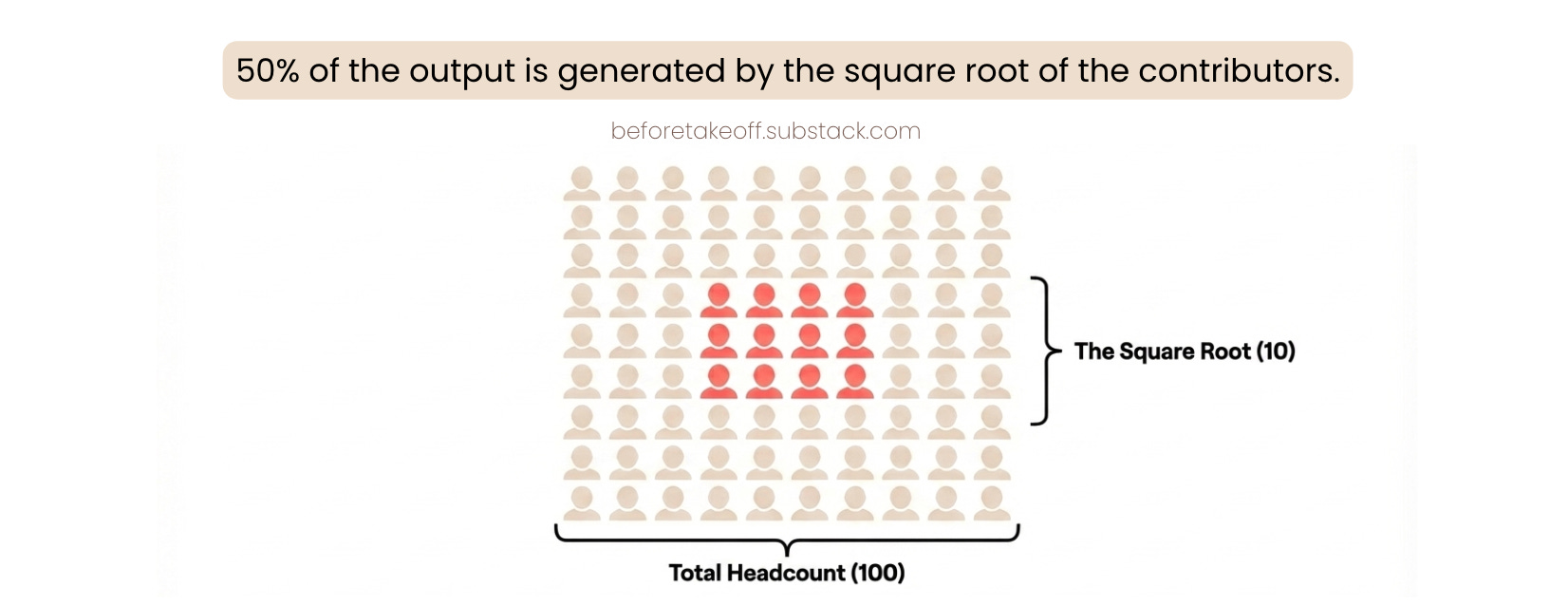
What this reveals is that as groups scale, the concentration of high-leverage contribution becomes a smaller and smaller fraction of the whole. The productive minority does not scale linearly with headcount. The rest of the organisation does.
For a founder building a small team, this goes beyond an interesting observation. It is a hiring and team design warning about what happens when headcount growth becomes the primary lever.
The Founder Is Always in the Square Root
In the early stage of building, Price’s Law works in your favour in one very specific way.
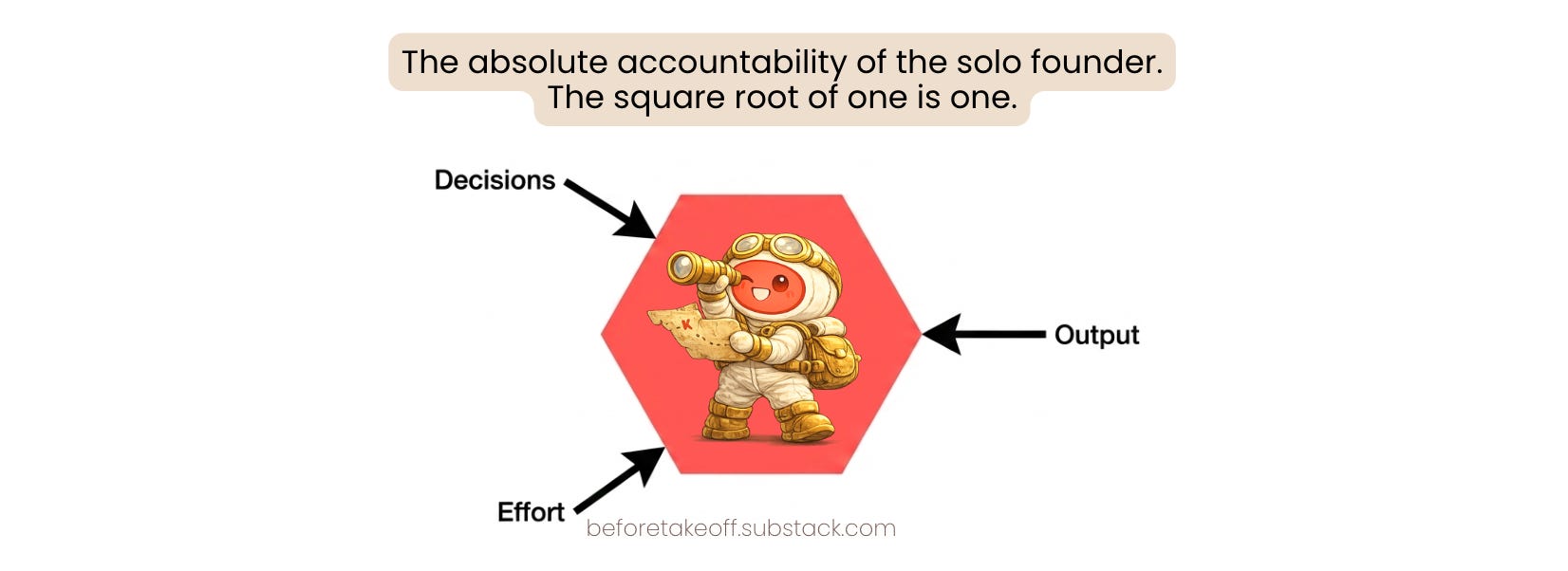
When you are a team of one or two, there is almost nowhere to hide from the work. The square root of one is one. Every unit of productive output belongs to you. Every gap in effort is visible. Every high-leverage decision is yours to make or avoid.
This is both the gift and the weight of solo founding and bootstrapping. The accountability structure is absolute, even when it is uncomfortable at times.
What I see happen is that founders begin to dilute that advantage by racing towards building a team of humans or AI agents early that has nothing to do with operational necessity. Having a team of humans or AI agents makes the business feel more established and distributes the weight of solo carrying.
Price’s Law tackles that instinct precisely for early stage businesses:
Every person, agent, software, or activity that is not in the productive square root does not hold a neutral position. They consume resources, coordination, and attention from the founders who are still doing most of the value-generating work.
The Maintenance Tax of the First Hire
The first hire creates what I call the Maintenance Tax: an ongoing cost to manage, onboard, coordinate, and direct, that hits immediately, long before the net productivity gain has even materialised.
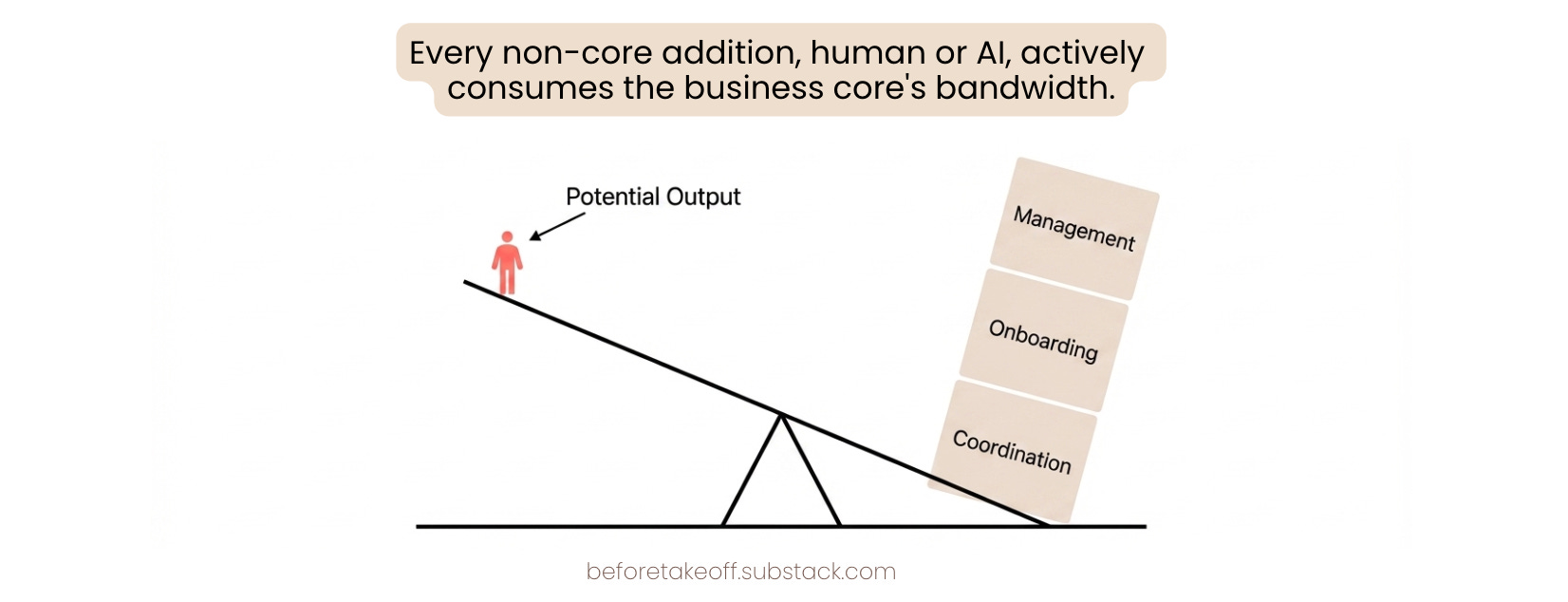
The question worth pondering on before any time or money investment into an early hire, software or activity is not “can we afford it?”. Instead, ask yourself “does investing in this create more coordination and management than contribution to our business core priority?”
Of course, some investments have to be made, in order to know if they could be the essential keys that unlock next level scaling or growth. The rule is to make it a contained experiment where time, focus, and financial commitment starts at the smallest meaningful unit possible and increase that unit by unit over time.
The Death Spiral Risk for Small Teams
Price’s Law carries one more warning that founders at the 5 to 15 person stage need to understand clearly.
At a small team level, that risk of losing a productive headcount is even more acute than larger organisations. In a team of nine, three people are doing half the work. Losing one of those three is not a 10% productivity loss. It is a structural collapse, because the remaining team does not automatically absorb the output.
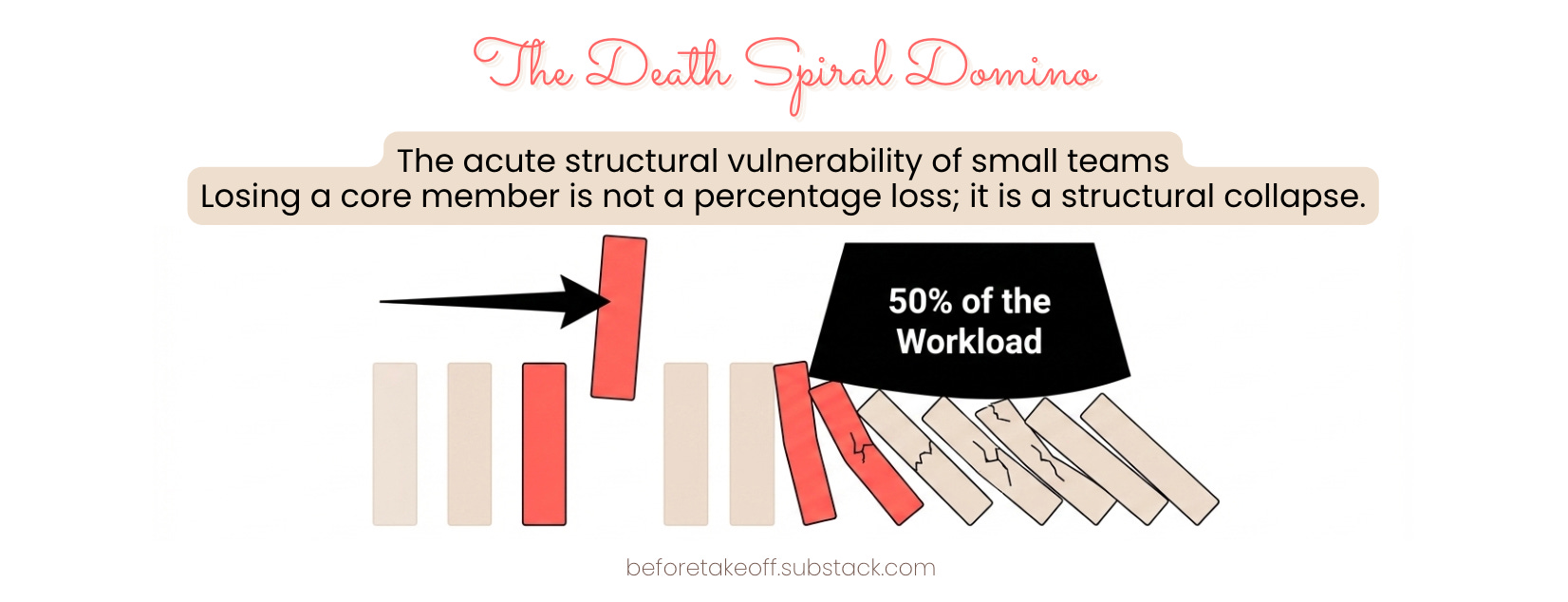
The conditions that trigger that talent exit are entirely predictable. High-output contributors are the most repulsed by environments where reward structures treat all contributors the same regardless of output or where policies in a downturn environment diminishes the weight of their outsized contribution.
The founders I see navigate this well tend to do two things:
They identify and protect their outlier contributors with structure, visibility, and meaningful ownership.
They resist the instinct to respond to a tough quarter by adding headcount or activities, when the actual problem is concentration and clarity of focus.
The Solo Founder Price’s Law Challenge
There is a version of this that applies even when a founder is still entirely solo, and it is worth naming directly.
A solo founder can face their own version of Price’s Law challenge. Across all the tasks, initiatives, offers, and channels they are running, only a fraction of those activities are generating the majority of actual business value. The rest are running on inertia, or on the founder’s reluctance to cut anything that has history and some validation behind it.
The productive square root of a founder’s attention is not their whole task list. It is the concentrated subset of activities that, if given proper focus, would compound into something durable.
This is why the Solo Founder Quarter Accountability framework I covered here begins with a constraint: one primary outcome for the 90 days. The constraint is designed to protect the productive minority of the founder’s focus from being diluted by everything else competing for the same finite bandwidth.
In Closing
Price’s Law is ultimately a precision argument. In any group, a small minority generates the majority of value. As the group grows, that minority becomes proportionally smaller, harder to identify, and more costly to lose.
For founders, the practical read is this: build with only the people, agents, tools, and activities you truly need that’s aligned to the business core priority for the quarter or year. Not the nice or great to have, as that can wait, apart from diluting your focus and impact.
When the investment is chosen with higher precision, your startup’s core priority will get better conditions to actually compound. Is your task list optimised for absolute necessity or is it running on the hopium that “more creates more”?
🧠 If today’s article resonated, you may want to read these next:
The Solo Founder Quarter: How to Plan Your 90 Days When You Have No Team to Hold You Accountable: On building the accountability structure that protects your most important 90-day outcome from the noise of everything else competing for your attention.
The Alive Tax: What It Really Costs to Keep Everything Running: Referencing OpenAI’s stepping back from Sora and the less on the hidden cost of maintaining too many active bets simultaneously, and why the real leverage is often in the cuts, not the additions.
Startup Revenue Maturity Curve: Why the Path to the First $100K is Different at Every Stage: On how a founder’s emotional relationship with money shifts across each revenue stage, and the distinct blind spots that come with each one.