

The Distribution Chasm: Why Founders Who Build in Silence Stay Invisible

The silence after launch is one of the most disorienting experiences in the early-stage founder journey, not because of what it says about the product, but because of how completely it upends the founder’s theory of how things were supposed to go.
You spend eight months building a flawless product. You solve a real problem. You hit publish, blast your limited email list, and wait for the floodgates of interest to open.
Instead, you get five waitlist signups. Three are your parents and sibling. One is you testing that the signup button works and another is your partner.
I have sat with founders in this painful moment more times than I can count.
The first founder response I almost always see is tactical. Better SEO. A Product Hunt push. Cold outreach. More content. More ads.
These solutions are not wrong. They just try to create distribution a little too late.
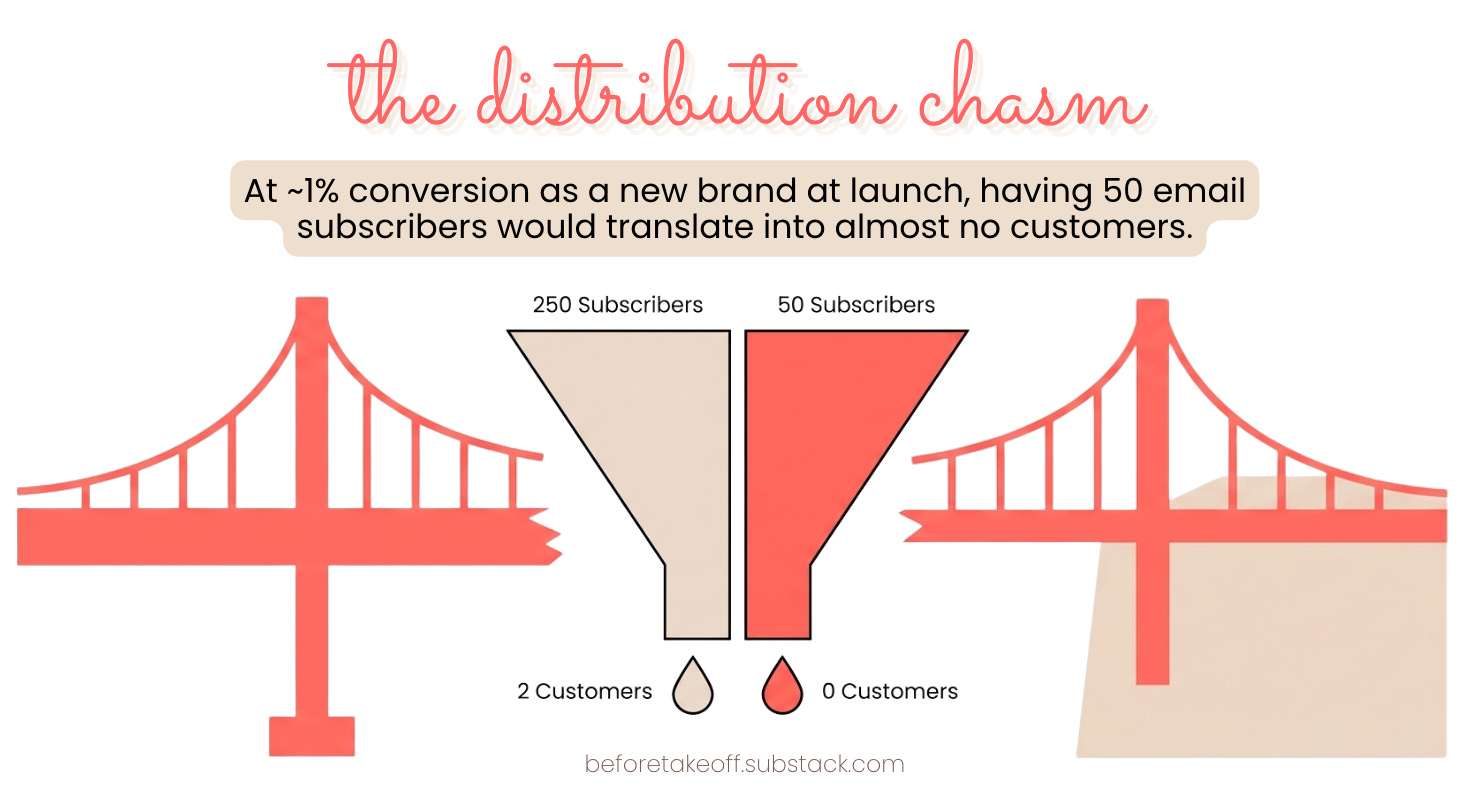
Founders in this situation often had what I call a Distribution Chasm where they are not reaching enough of their target market to win their first sales.
If as a new brand, you need 250 subscribers of convert 2 customers at launch, and your mailing list is only 50, mathematically the first customer just can’t be born.
That distribution chasm didn’t appear on day one of launch. It began on the day the founders started building. This is the same pattern I’ve seen across early-stage startups where founders often push harder on tactics when the real issue is that a key condition hasn’t been unlocked yet. I break this down in “The Locked Gates Keeping Founders Stuck” (read the article here).
And all this is assuming that your target market do want to buy your product as 250 subscribers don’t always equal 250 interested customers, especially for a new brand. They could very well be 80 interested customers, 120 curious customers, 20 competitors, and 30 customers who subscribed on the spur of the moment.
The 3 Thinking Traps of the Invisible Founder
If building visibility and distribution in parallel with product is so important, why do so many founders still build in silence?
In my advisory work, this founder challenge comes up regularly. Most founders I work with know visibility and creating distribution are critical for their startup success. And yet they still go dark.
After sitting with this pattern across countless founders over the years, I have identified three most common thinking traps that are often disguised as discipline.
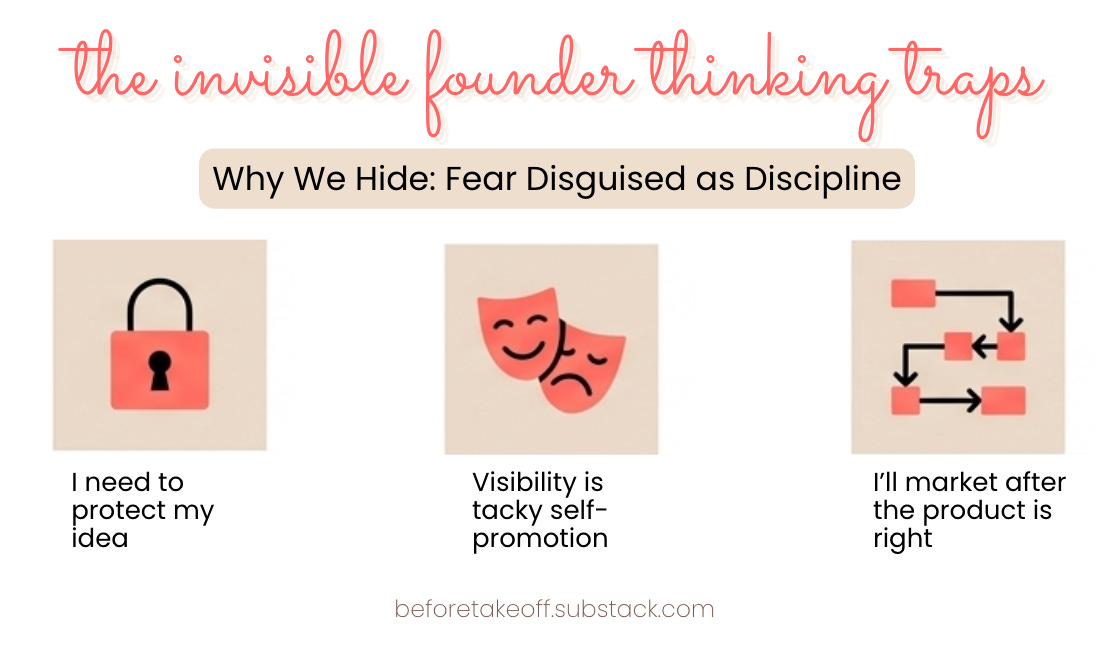
The first is fear of idea theft. In my experience, sharing your idea early might attract idea thieves but that’s something you’ll always have to win against, even post launch. These days, it’s extremely easy for content, ideas, and products to be copied. Execution, which used to be the differentiator, is no longer the reliable moat that can protect a startup’s unique advantage. What’s left now are brand and distribution, with the former being increasingly clonable as well. So that leaves us with distribution.
The second is imposter syndrome. Especially for founders who come from technical backgrounds or senior roles in their corporate career, online visibility feels like tacky self-promotion. They would rather let their work speak for itself. So they delay visibility activity until their product feels perfect or complete. But it takes time to create an effective system of turning visibility into a sizeable distribution. Just because you showed up online and posted content sometimes, doesn’t mean you’ll get enough of your target market to know, like, and trust you.
The third is misguided sequencing. This one is the most common because it sounds strategically responsible. “Let me get the product right first, then I will focus on finding customers.” The founder tells themselves this is disciplined restraint. In practice, the product will never be good enough without market feedback on it. Also to create a truly winning product, a lot of time, research, and development need to go into it and that could take years. By then, most new businesses might have run of cash or the founder would have run out of motivation.
All three of these traps lead to the same outcome. A founder who has built something real, for a real problem, and still has to introduce themselves to the market almost as a complete stranger on launch day.
Think of it as being the best talent or expert on your craft, but no one knows or trusts you. Landing your first gigs is going to take time.
And unless there’s a lot of cash, time, creativity, and expertise in the reserve in pump up high converting visibility in a short time, most founders would take 9 to even 18 months to attract a meaningful distribution base of ideal customers.
The Distribution Building Clock
When I introduce this framework in advisory sessions, I often emphasise one thing from the start.
The pre-launch distribution clock does not start when the code is finished or when the product is created. It starts when you decide what to build, sometimes even before.
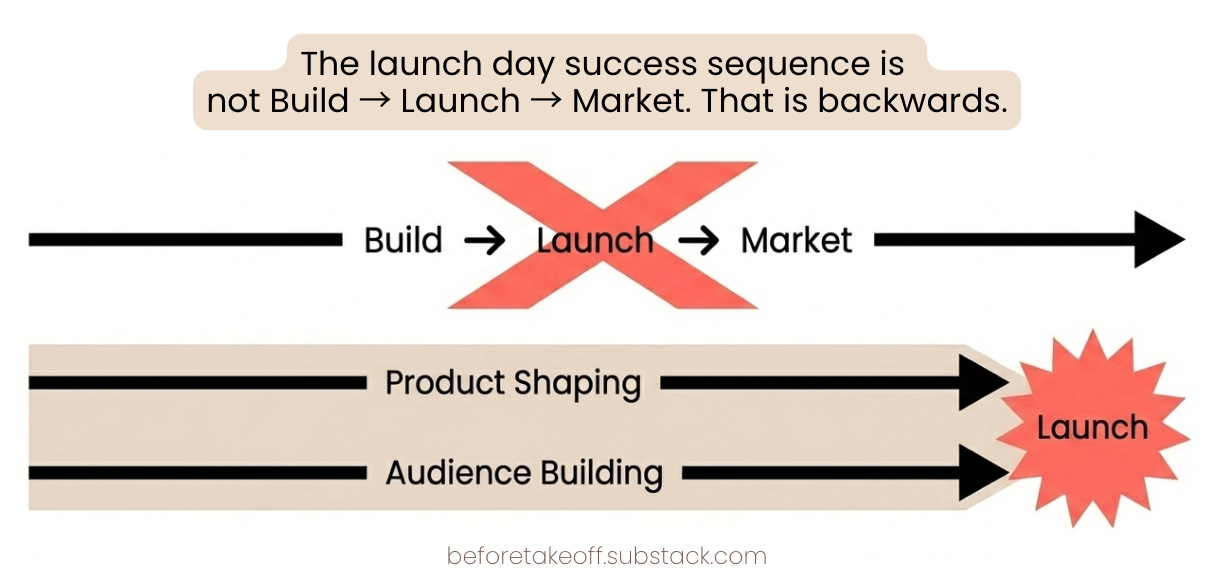
Most founders think the sequence is Build → Launch → Market. That is backwards. The true sequence requires you to show up before you feel ready, and stay visible while the product is being shaped.
The Distribution Building Clock has five phases from pre-to-post-launch.
Phase 1: Interest Collection. This is the work of validating interest. Who is actively talking about this problem? How are they describing the problem? Where are they gathering? If there are no active conversations happening somewhere in the world about the problem you are solving, that is a sign to potentially pause to refine your idea or pivot. The discipline of this phase is listening before speaking.
Phase 2: Building Presence. This is when you begin sharing what you are learning. Reflect the problem back to the market. Become recognisable while you still think you are not ready. You are not building a brand at this stage. You are building your presence online as a visible thinker and contributor to the problem you are solving.
Phase 3: Proof of Demand. DMs from people who relate to what you are sharing. Email signups to be on the waitlist for what you’re building. People asking when the thing will be ready and referring to their network. No engagement here often is a sign to stop building further. Sometimes founder tackle problems that people don’t want to pay to solve or to disrupt status quo through a new, alternative option.
Phase 4: Co-Creation. The product launches and enters the public consciousness. You are responding to what the market is telling you and no longer guessing from assumptions. Mastering the loop of learning from the market and iterating the offer at this stage is the key that unlocks your first sales.
Phase 5: Rinse and Repeat. There is no big moment. Just continuous repeating and refining what works until enough momentum snowballs into a critical takeoff point. Depending on what you’re selling and how much audience access and brand authority you have, this can easily take 6-9 months to even 3 years to reach the first base of meaningful success.
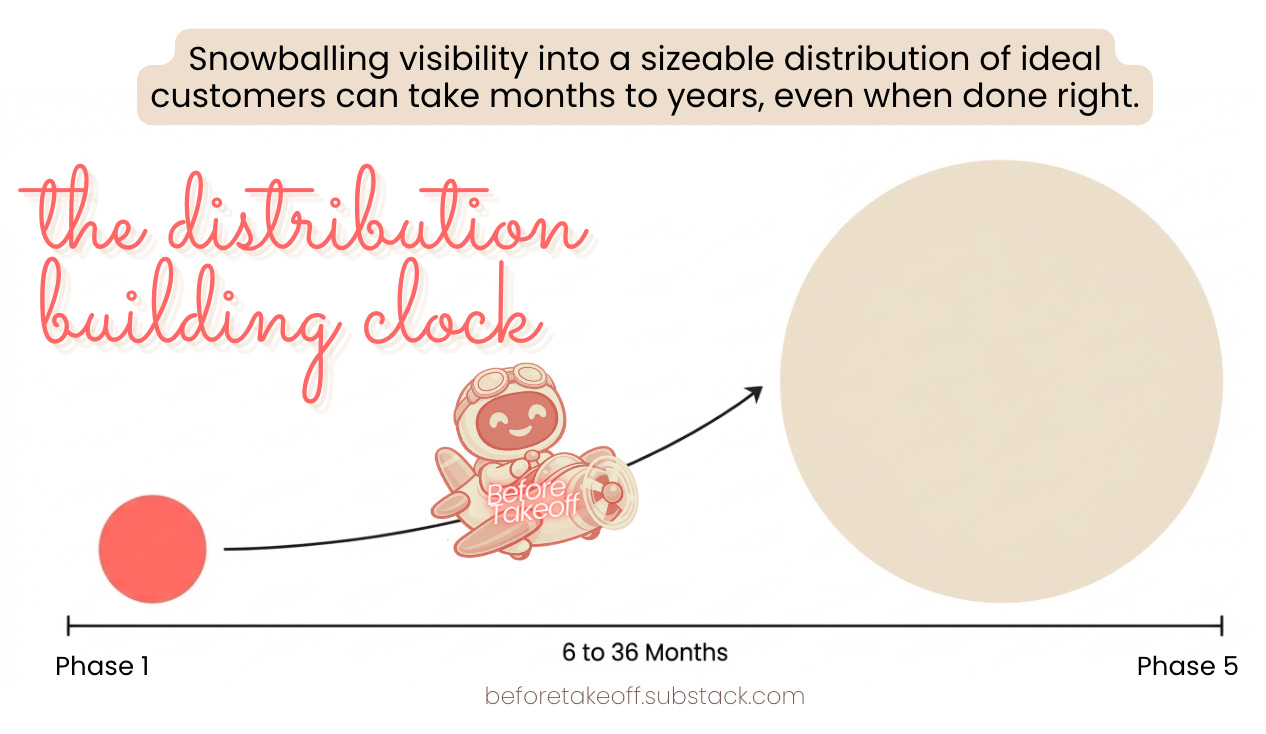
If this feels slow or invisible, it’s often because you’re still in the early stages of a compounding loop forming, similar to how content flywheels take years before momentum becomes obvious. I explored this in The Quiet Content Flywheel, read the article here.
The founders who succeed earlier are not louder, they simply started building visibility for distribution earlier and avoided the invisible founder trap.
From Cold Introductions to Warm Reunions
When founders come to me after experiencing a quiet launch, the first question I ask is “Did you build a distribution channel while building your product?”.
If the answer is no, the situation is a call for recalibration. The distribution work that should have run in parallel with building must now run in parallel with selling. It will take longer and feel harder, but it is not irreversible.
The founders who figure this out, stop asking “How do I get people to notice this?” and start asking instead: “Who should already know me before they ever need to buy from me?”
That question, when acted on with consistency, will decide if you are introducing yourself to a room full of strangers and reuniting with a community that has been waiting to engage further.
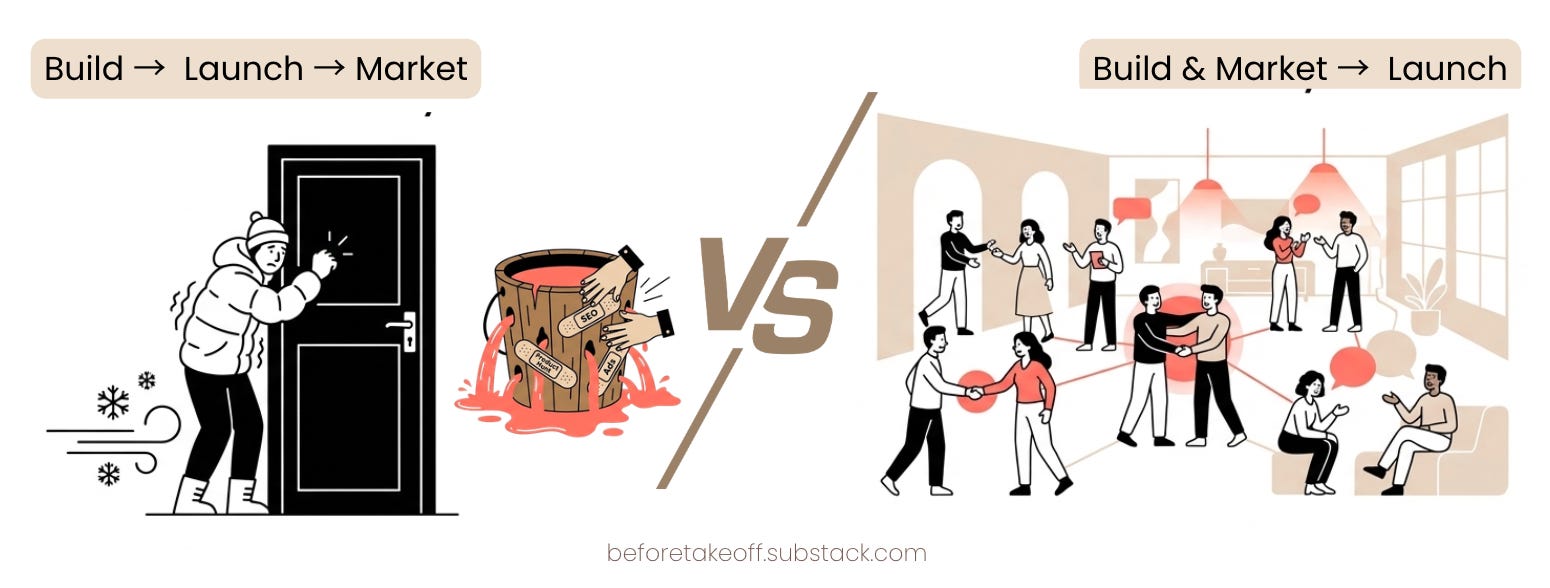
Build the audience before you need the customers. That is the sequence most startups skip. But it’s what turns launch day from feeling like being out and about door knocking and selling in winter to a warm reunion indoors filled with a virtual room of your ideal customers.